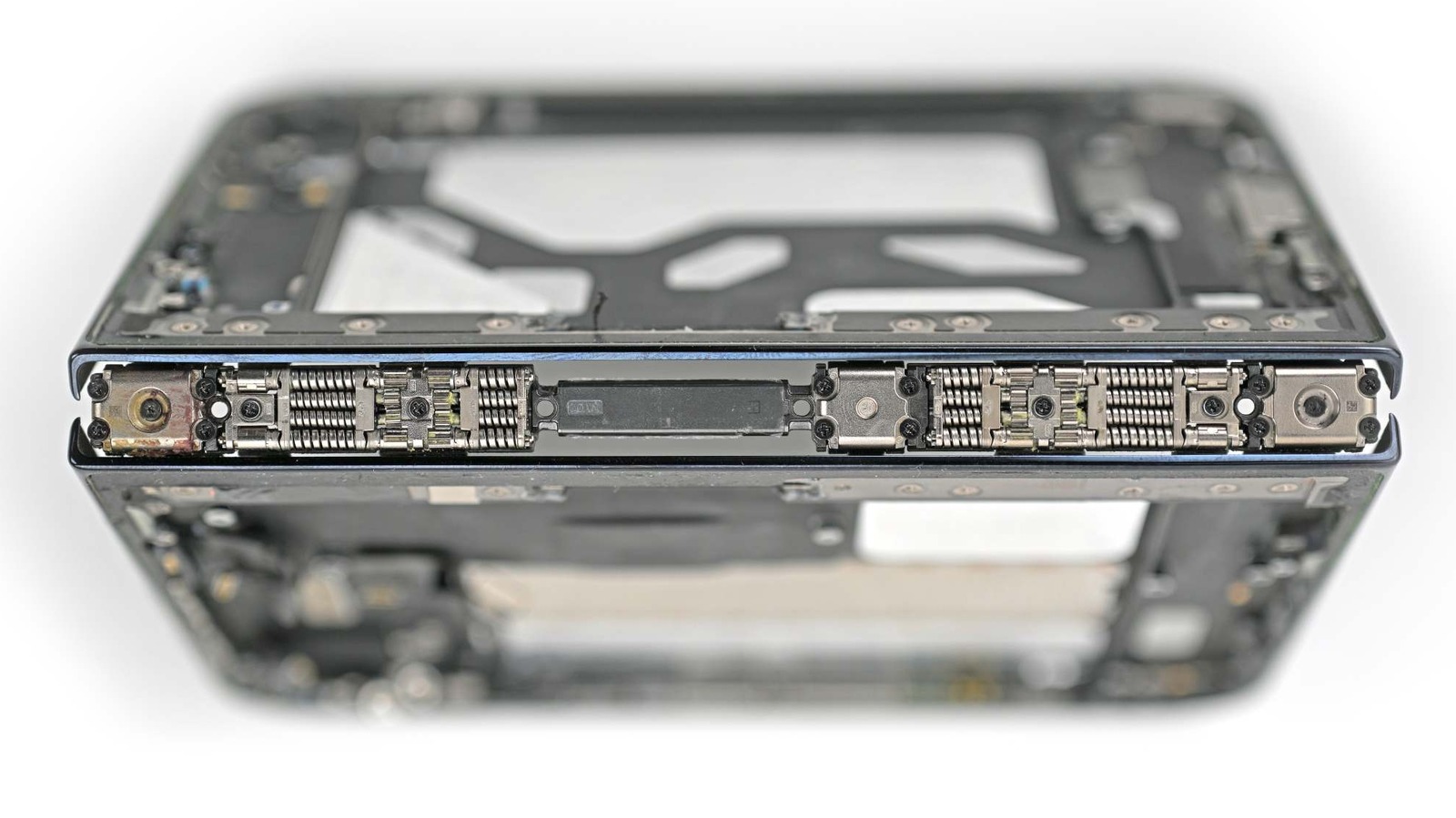
What did iFixit discover about the iPhone Duo hinge?
iFixit’s latest teardown of the iPhone Duo, released on Oct. 26 2026, shows that the device’s folding display relies on a complex hinge that may be the root of recent screen-crack reports. The teardown combined footage from the disassembly, patent drawings and CT scans to model the hinge’s internal geometry. The model revealed two key elements: a series of retractable curved guides that extend when the display folds and a center support bar that drops to accommodate the fold. In simulations, the center bar did not retract far enough, creating a stress point where the outer display contacts the bar. This mechanical interaction could explain the green-line crack pattern that some users report.
How does the Duo hide the fold crease?
Apple used a dual-layer approach to mask the crease. First, the curved guides and support bar shape the display so that the fold line is as smooth as possible. Second, the screen employs oval pixels arranged to blur the crease, and a nano-texture coating further diffuses the visual seam. iFixit demonstrated the effect by placing the display under a high-magnification microscope, showing how the pixel alignment and coating work together to conceal the fold.
What does the teardown say about dust ingress?
Despite the Duo’s IP68 dust-resistance rating, iFixit found that fine particles can still reach the hinge mechanism. The internal parts are sealed, but the hinge itself appears not to be fully dust-sealed. Dust ingress can cause the hinge to “crunch” and damage the screen, producing the same green-line pattern seen by users. The report advises caution when using the device in sandy or dusty environments, such as beaches.
How repairable is the iPhone Duo?
iFixit evaluated the device’s repairability by removing the outer screen, battery, and other small components. The inner display and hinge were identified as the most difficult to access, accounting for the largest deduction in the repair score. The group gave the Duo a provisional 5/10 repair score, pending the availability of replacement parts. Many owners are already opting for AppleCare+ coverage, citing the early reports of screen failures and the complexity of the hinge assembly.
What are the practical implications for users?
Users who experience screen cracks may find that the damage originates from the hinge’s mechanical design rather than a manufacturing defect in the display panel itself. Repairing the hinge or replacing the entire display is likely required, and the process is not straightforward. The teardown suggests that the Duo’s folding mechanism, while a selling point, introduces a new failure mode that could affect long-term durability.
What should Apple consider moving forward?
The findings point to a need for tighter control over the hinge’s retractable elements and improved dust sealing. If Apple can redesign the center support bar to retract fully and seal the hinge against fine particles, it may reduce the incidence of screen cracks. Until such changes are made, users should avoid exposing the Duo to environments with high dust or sand content.
How does this compare to other folding phones?
iFixit notes that dust ingress into hinge mechanisms is a common issue across folding phones, not unique to the Duo. However, the Duo’s specific combination of retractable guides and a center bar creates a distinct stress point that may not be present in other designs. The teardown highlights the importance of detailed mechanical analysis when evaluating foldable devices.
Where can I learn more about repairing my Duo?
The full iFixit teardown guide includes step-by-step instructions and part lists. The guide also discusses the availability of replacement parts and the estimated cost of a professional repair.
iPhone Duo hinge design and screen-crack risk
The teardown shows that the hinge’s retractable curved guides and center support bar can create a stress point that leads to the green-line crack pattern. The stress point forms when the center bar does not retract fully, forcing the outer display to contact the bar during a fold. This mechanical interaction is a new failure mode that Apple has not addressed in the current design.
Dust ingress and IP68 rating
Although the Duo carries an IP68 rating, the hinge itself is not fully dust-sealed. Fine particles can reach the hinge mechanism, causing it to “crunch” and damage the screen. Users in dusty or sandy environments should exercise caution, as the hinge’s lack of dust sealing can accelerate screen damage.
Repairability and cost implications
The Duo’s hinge and inner display are difficult to access, resulting in a provisional 5/10 repair score. Replacement parts are scarce, and professional repair costs are high. Many owners are opting for AppleCare+ coverage to mitigate the risk of costly repairs.
Related coverage
- Old Chromebook Repurpose: Keep Your Device Alive After a Googlebook Upgrade
- Android 17 app bubbles: Pin apps to the top of your screen
- Google privacy policy now permits Gmail data to feed ad targeting via Personal Intelligence