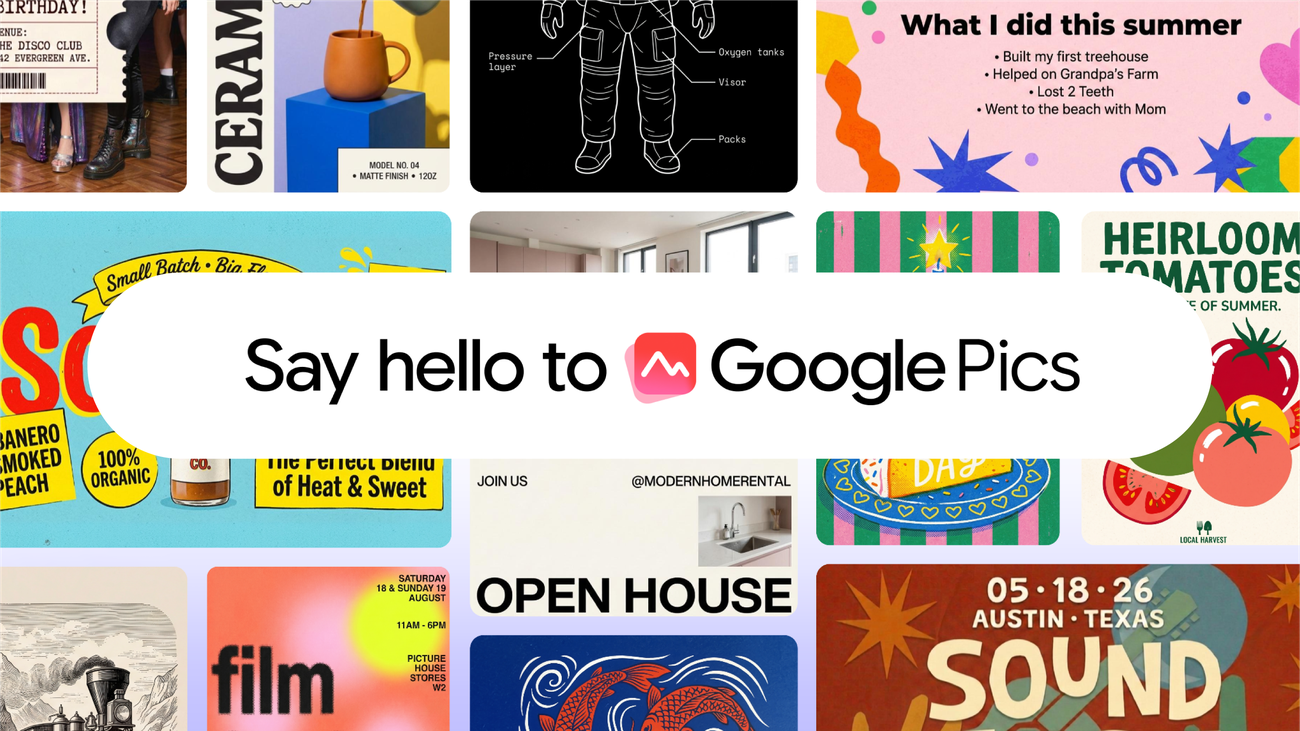
Core Announcement
Google has embedded its new generative-image service, Google Pics, into Google Workspace, allowing users to generate, refine and co-create images directly within Docs, Slides and Drive. The rollout begins with AI Pro and Ultra subscription tiers on September 1, 2026, and the company promises tighter integration across the suite later in the year. The feature runs on a Gemini-derived diffusion model that has been fine-tuned for corporate branding guidelines and data-privacy constraints. For the official launch details see the Google Workspace blog.
Technical Context
The underlying model builds on Gemini’s multimodal architecture, combining a transformer-based text encoder with a latent diffusion decoder. While Google has not disclosed exact parameter counts, internal benchmarks suggest a 2-to-3-fold reduction in inference latency compared with earlier Gemini-1 diffusion releases, achieved through tensor-core optimizations on the latest TPU v5p. The model operates within Google’s data-center edge, ensuring that generated assets never leave the corporate firewall unless explicitly exported.
Impact on the Developer Ecosystem
By exposing the image generation API through Workspace’s existing Apps Script environment, developers can now script automated visual content pipelines. A sales ops team could trigger a custom slide deck that auto-populates product screenshots with brand-compliant graphics generated on-the-fly. This lowers the barrier for non-designers to produce high-quality visuals, potentially reducing reliance on external design tools and freelance services. The move also aligns with Google’s broader strategy to embed AI primitives across its cloud portfolio, echoing recent announcements around Gemini Notebook and AI-enhanced Cloud Functions.
Risk and Governance
Enterprise adoption hinges on governance. Google Pics includes admin-level policy controls that let organizations whitelist permissible prompts, enforce watermarking, and retain audit logs of generated assets. These measures address concerns around brand dilution, copyright infringement, and inadvertent generation of disallowed content. Nevertheless, the diffusion model’s stochastic nature means that occasional artifacts may slip through, requiring human review for high-stakes communications.
Operational Consequences
From an IT perspective, the service adds modest compute overhead to Workspace workloads. Early testing indicates an average of 0.8 seconds per 512 × 512 pixel generation on a standard TPU-v5p slice, translating to negligible impact on typical document editing latency. Bulk-generation scenarios—such as mass-producing marketing assets—could strain shared TPU quotas, prompting admins to allocate dedicated capacity or schedule jobs during off-peak windows.
Market Positioning
Google’s entry competes directly with Microsoft’s Designer integration in Office 365 and Adobe’s Firefly suite. By leveraging its existing Workspace user base—estimated at over 300 million active accounts—Google can accelerate adoption without requiring customers to migrate platforms. The decision to launch first to premium subscribers mirrors a “beta-in-the-wild” approach, gathering usage telemetry while limiting exposure to risk-averse enterprises.
What to Watch Next
The next phase will extend Google Pics into real-time collaborative editing, allowing multiple users to tweak a generated image simultaneously. Additionally, Google has hinted at a forthcoming “Drive-native” library where generated assets are automatically indexed for semantic search, leveraging the same embeddings that power Gemini’s text-search capabilities. Observers should monitor how Google balances model openness with the need for proprietary safeguards, especially as regulatory bodies like the NIST AI program tighten standards for generative content.
Broader Implications for Generative AI
Google Pics illustrates a shift from standalone AI products to tightly coupled workflow tools. This integration model reduces friction for end-users but raises the bar for compliance teams, who must now audit AI-generated media alongside traditional documents. The move also underscores the importance of on-premise or edge-hosted inference, a trend echoed in recent discussions on secure AI deployment.
Google Pics Use Cases
Enterprises can embed image generation into onboarding kits, auto-create brand-consistent diagrams for technical manuals, or personalize customer-facing presentations at scale. Marketing squads gain a rapid-iteration loop for A/B testing visual concepts, while support teams can generate illustrative screenshots on demand, cutting resolution times. These concrete scenarios demonstrate how the primary keyword Google Pics becomes a productivity lever across multiple departments.
Related coverage
- DoorDash Flux cloud agents Accelerate 130K Engineering Tasks in the Cloud
- Cloudflare AI Search Custom Data Boosts Agent and Developer Queries
- Pixel 11 Gemini AI: Elevating On-Device Tensor Architecture