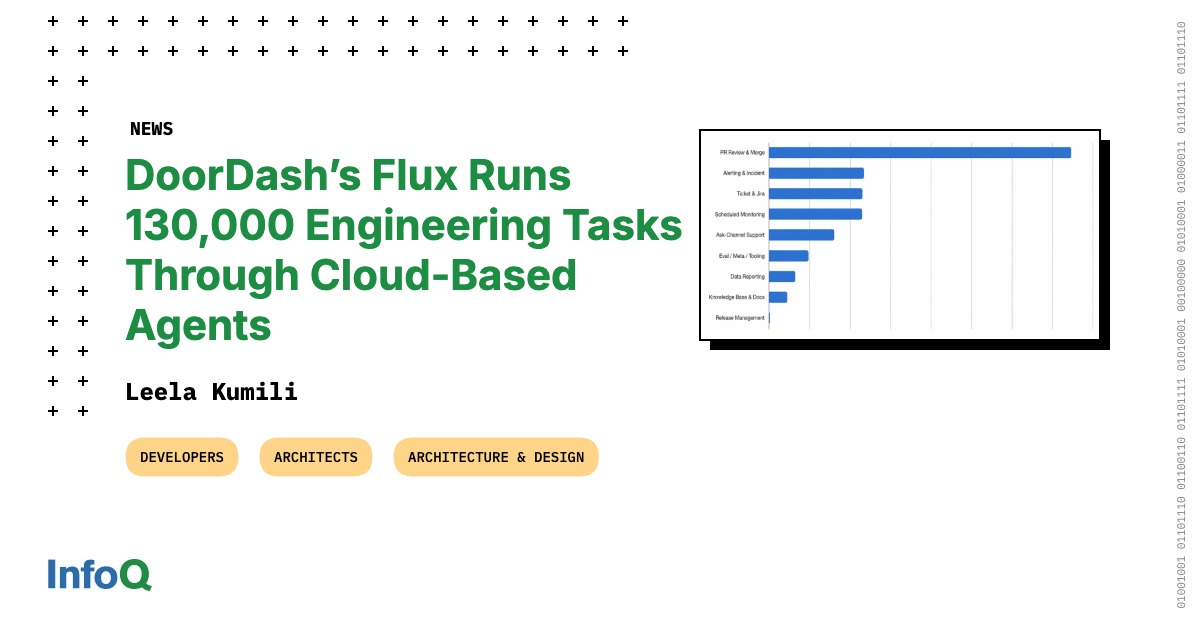
DoorDash Flux cloud agents boost productivity
DoorDash Flux cloud agents have now executed more than 130,000 engineering tasks on managed cloud agents, moving compile, test, and lint workloads away from developers' laptops. The shift challenges the long-standing belief that developers must own the compute cycle for every change and demonstrates that a cloud-native execution model can deliver comparable latency while freeing local resources.
Why the laptop-centric assumption is crumbling
For years, CI/CD pipelines relied on a hybrid model: quick unit tests run locally, then larger integration jobs run in remote pipelines. The premise was that local machines provide the fastest feedback loop. DoorDash Flux cloud agents prove that a containerized agent in a private cloud can match or exceed that feedback speed, eliminating thermal throttling and environment drift.
Technical blueprint of DoorDash Flux cloud agents
Flux agents are containerized runtimes provisioned on DoorDash’s private cloud clusters. Each agent spins up on demand, pulls the exact code snapshot, and executes a predefined task graph. Key specifications include:
- CPU: 8-core AMD EPYC 7543 (2.8 GHz) per agent
- Memory: 32 GB DDR4 per instance
- Storage: NVMe SSD with 500 GB burst capacity
- Network: 10 Gbps intra-cluster fabric, enabling sub-second artifact transfer
- Isolation: gVisor sandbox for security isolation These specs allow a typical Go microservice to compile in under 12 seconds, a 30 % improvement over the average developer laptop benchmark recorded in internal DoorDash surveys.
Security implications of centralized agents
Running code in the cloud introduces a new attack surface. While gVisor mitigates container escape, the centralization of build artifacts creates a lucrative target for supply-chain adversaries. DoorDash mitigates risk with signed build manifests, immutable artifact storage, and strict least-privilege IAM roles. Organizations adopting similar agent-centric pipelines must audit credential distribution and enforce role-based access controls.
Cost dynamics: hidden savings or new expenses?
At first glance, 130,000 cloud tasks appear costly. DoorDash reports a 22 % reduction in total compute spend compared to the previous laptop-heavy model, attributing savings to higher utilization rates and the ability to power-down idle agents. The shift moves spend from capital expenditure (laptop upgrades) to operational expenditure (cloud usage). Companies with tight OPEX budgets should model peak concurrency to avoid surprise spikes.
Developer experience: faster feedback or new friction?
Flux’s promise of “instantaneous” feedback hinges on network latency. In DoorDash’s internal network, round-trip time is sub-10 ms, but remote teams on the public internet may see higher delays. To mitigate this, Flux supports edge-proxied agents that sit closer to developers’ locations, a feature that could become a differentiator for multi-regional engineering orgs.
Market ripple effects
The success of DoorDash Flux cloud agents could accelerate adoption of cloud-native build agents across the industry. Competitors such as GitHub Actions, GitLab CI, and CircleCI already offer hosted runners, but they typically target generic workloads. DoorDash’s high-throughput, specialized agent pool demonstrates that bespoke internal platforms can outperform generic SaaS solutions, potentially prompting larger cloud providers to offer more granular, per-task pricing tiers.
Regulatory and compliance lens
For regulated sectors—finance, healthcare, government—moving code execution off-premises raises compliance questions. DoorDash mitigates this by keeping agents within its own VPC and ensuring data never leaves the corporate boundary. Firms must verify that such architectures satisfy standards like SOC 2, ISO 27001, and GDPR data-processing requirements.
What teams should watch next
- Agent orchestration standards: Emerging open-source projects aim to standardize agent APIs, lowering lock-in risk.
- Edge-proxied agents: Monitoring latency trends for remote developers will be critical.
- Supply-chain hardening: Expect tighter integration of SBOM checks within agent pipelines.
- Cost monitoring tools: Real-time dashboards that correlate task volume with cloud spend will become essential.
The bigger debate: centralization vs. autonomy
Flux forces a reevaluation of the “developer-first” mantra. While centralization yields performance and security benefits, it also concentrates control in platform teams, potentially slowing innovation if change-approval processes become bottlenecks. Organizations must balance efficiency gains against the risk of stifling developer autonomy.
The AI angle
Flux’s uniform execution environment is primed for AI-assisted tooling. By exposing a consistent runtime, DoorDash can plug in LLM-driven code reviewers or automated test generators without worrying about heterogeneous local setups. This aligns with broader industry trends where AI agents augment the CI pipeline.
Trusted reference
For deeper insight into optimizing cloud workloads, see the guide from AWS on compute optimization: AWS Compute Optimizer.
Bottom line
DoorDash Flux cloud agents demonstrate that moving 130,000 engineering tasks to the cloud is not a futuristic experiment but a practical, cost-effective reality. The move challenges the long-standing belief that developers must rely on their own machines for rapid feedback. As more firms contemplate similar migrations, the conversation will shift from “if” to “how,” balancing security, cost, and developer experience in a cloud-first build paradigm.
Related coverage
- Cloudflare AI Search Custom Data Boosts Agent and Developer Queries
- Google auto expand AI overview reshapes search results
- Bluesky discover feed opt out: New setting stops accidental virality