Airbnb Chronon Cuts Recommendation Staleness from 2 Days to Seconds
Airbnb announced on October 15, 2026 that its new Chronon system has reduced recommendation staleness from a two-day window to a few seconds. The change means that a guest who views a listing today will see that listing in the top-10 recommendations within seconds, rather than waiting for the nightly batch that previously refreshed the model.
How Chronon Achieves Near-Real-Time Recommendations
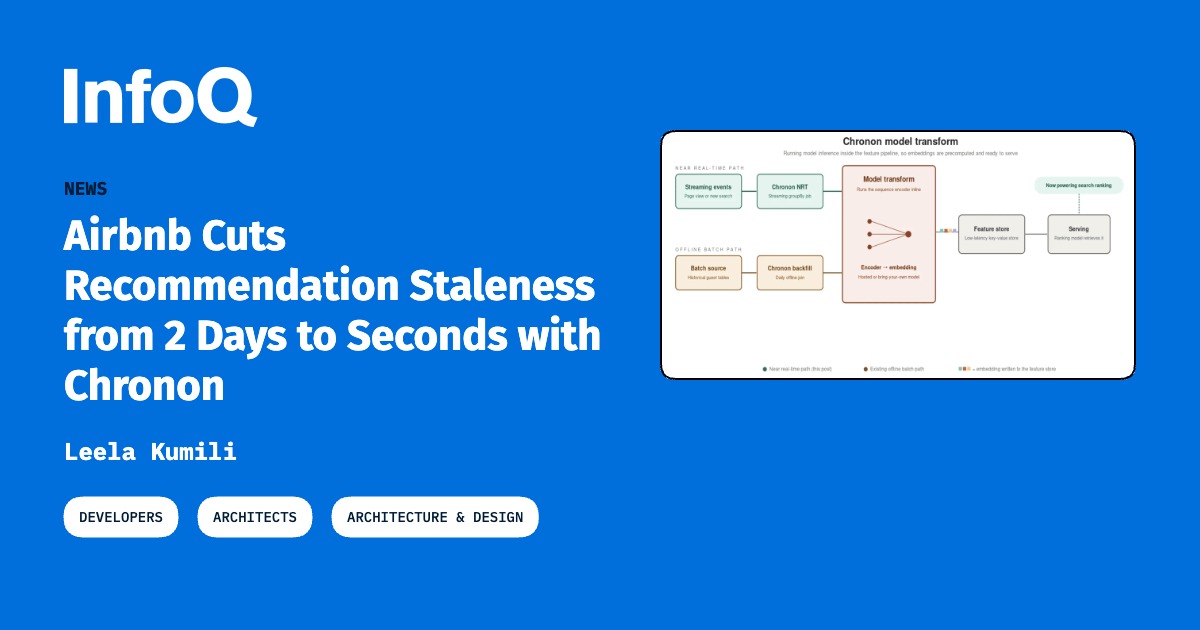
Chronon is built on a distributed event-driven architecture. User actions—such as clicks, bookings, and search queries—are streamed through Kafka topics. Flink jobs consume those streams, update feature tables in a low-latency storage layer, and trigger model retraining on a rolling basis. The updated models are then pushed to a serving layer that delivers predictions with sub-second latency.
The system replaces the legacy batch pipeline that ran nightly and produced a static recommendation set for the next day. By moving to continuous ingestion, Airbnb eliminates the two-day lag that previously caused mismatches between user intent and displayed options.
Impact on Hosts and Guests
For guests, the immediate effect is a more responsive search experience. A guest who changes their travel dates mid-search will see updated availability and pricing in real time. Hosts benefit from higher conversion rates because their listings appear in relevant recommendations as soon as a potential guest expresses interest.
Airbnb reports that early pilots of Chronon saw a 3.5% lift in click-through rates on recommended listings and a 1.2% increase in booking conversion for hosts in the pilot region. These figures are preliminary and derived from a cohort of 10,000 active hosts and 200,000 guest sessions during the first month of deployment.
Deployment Considerations
Integrating Chronon into Airbnb’s existing data ecosystem required several changes. The engineering team had to expose new Kafka topics, upgrade the Flink cluster to version 1.13, and add a new Redis cache layer to store intermediate feature vectors. The deployment also introduced a new monitoring dashboard that tracks stream lag, model drift, and serving latency.
Because the system processes events in real time, Airbnb must also address data consistency. The engineering notes that the team uses a two-phase commit protocol to ensure that feature updates and model weights are applied atomically across services. However, the protocol introduces a small window of inconsistency that could affect recommendation quality during peak traffic.
Risks and Trade-offs
While the latency gains are clear, the shift to continuous processing brings new operational risks. The increased volume of real-time data strains the Kafka cluster, requiring more brokers and higher network throughput. Additionally, the continuous retraining pipeline can amplify model drift if not properly monitored.
Airbnb’s engineering blog warns that the system’s reliance on real-time data may expose it to noisy signals, such as temporary spikes in search volume during holidays. The team mitigates this by applying a decay factor to recent events, but the effectiveness of this approach remains to be validated at scale.
What to Watch Next
Airbnb plans to roll out Chronon to all markets by Q4 2027. The company will also experiment with multi-modal recommendation models that incorporate visual and textual features from listings. Future updates may reduce latency further by moving some inference to the edge, but that will require new hardware deployments in data centers.
The broader industry will likely follow Airbnb’s lead, as other platforms face similar challenges with stale recommendations. Observers should monitor how Airbnb balances latency, consistency, and operational complexity as Chronon matures.
Related coverage
- Apple iOS 27.2 Adds Siri Memory, Expanded Data Sources and New Music Branding
- Ralph Earle Poetry: Of Code and Shortleaf Pine
- OpenAI Shuts Frontier Model Training Offline, Citing Alignment Risks