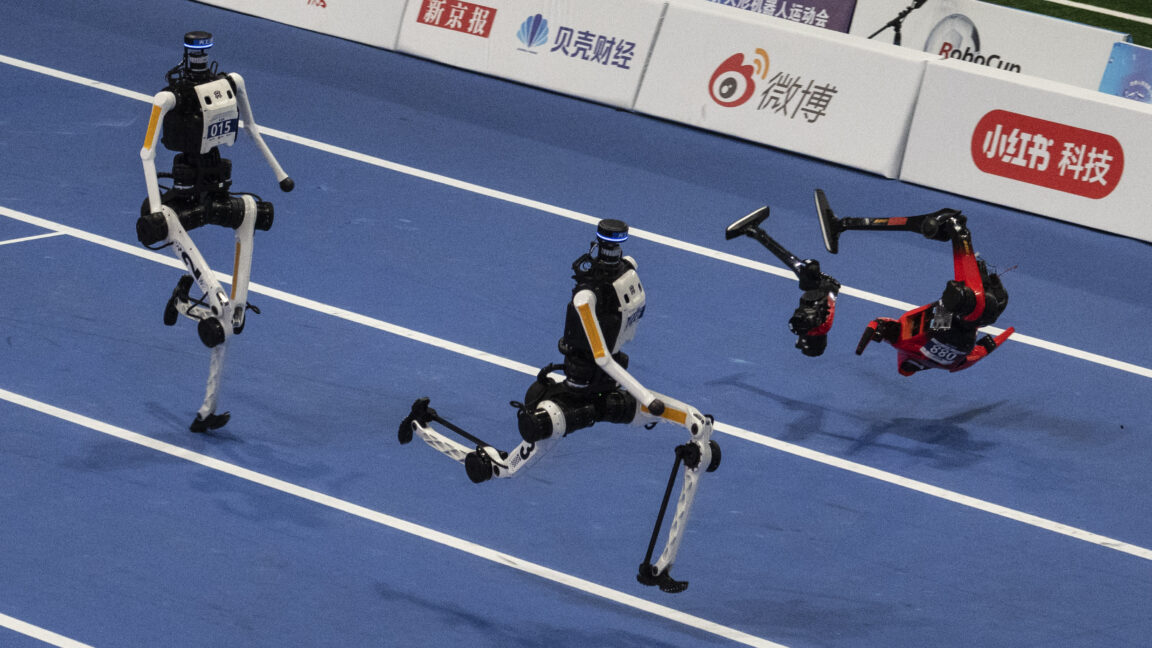
Record-Breaking Sprints and Unexpected Fires
The 2026 World Humanoid Robot Games in Beijing delivered a headline-grabbing moment: a humanoid robot ran the 100-meter dash in 9.58 seconds, the exact time of Usain Bolt's 2009 world record. The Tiangong Ultra, built by Tian Gong Robotics, crossed the line first in the large-robot category, a feat confirmed by the event organizers and reported by Ars Technica. While the sprint captured global attention, the same heat produced a dramatic safety incident: an Honor-brand humanoid fractured at the waist and erupted in sparks, with two other units igniting their joint housings. Engineers traced the failures to aggressive motor torque settings and a lack of active braking algorithms. The robots were programmed to sprint straight to the finish line; once past the line, they continued at full speed because the control software had no deceleration routine.
The incident highlights the need for improved safety mechanisms in humanoid robots. The current designs lack closed-loop speed regulation after the finish line, and thermal sensors are either absent or not integrated into the motor driver firmware. This can lead to overheating and catastrophic failures. To address this issue, developers must prioritize the implementation of robust safety layers, including thermal monitoring and emergency stop mechanisms.
How did the robots achieve human-level sprint speed?
The breakthrough stems from advances in whole-body control architectures that synchronize 30+ actuated joints in real time. Researchers at Purdue University, working with the U.S. Army DevCom Lab, highlighted that the new control loops run at 1 kHz on custom ASICs, allowing sub-millisecond coordination of leg, arm, and torso dynamics. Reinforcement-learning policies trained in high-fidelity simulation were then transferred to the hardware via domain-randomization, reducing the sim-to-real gap.Humanoid Robot Games 2026: Safety Lessons
The sprint success demonstrates the power of "whole-body control"—the ability to command every joint simultaneously for a single, highly optimized task. This represents a shift from earlier prototypes that could only execute pre-programmed gait cycles. The new control stacks leverage model-predictive control (MPC) combined with learned residual policies, delivering both precision and adaptability.
However, the safety incidents during the games underscore the importance of prioritizing safety in humanoid robot design. The lack of closed-loop speed regulation and thermal monitoring can have severe consequences, including robot damage and potential harm to humans. To mitigate these risks, developers must invest in the development of robust safety mechanisms, including predictive braking and thermal management systems.
Flashy Events vs. Practical Benchmarks
Beyond the sprint, the games featured kung fu routines, kickboxing bouts, and a soccer match, all designed to showcase dynamic balance and rapid decision-making. Organizers also introduced mundane household-task challenges—laundry washing, folding, and room cleaning—to gauge real-world applicability. In these scenarios, robots lagged significantly behind human operators, completing a 30-minute laundry cycle in over an hour.
A Beijing-based startup, X-Humanoid, earned viral fame when its unit won the 400-meter race using a "shy-person" arm posture. The developers disclosed that the robot learned this gait through reinforcement learning in simulation, where the policy shifted arm swing to a protective position while maintaining hip-driven propulsion.
Why do practical tasks matter more than sprint records?
Sprint times are impressive but represent a narrow, single-objective optimization. Real-world deployment demands multi-task flexibility, safe interaction with humans, and energy efficiency. Household chores test perception, manipulation, and long-duration reliability—areas where current humanoids still fall short.Investment and Market Implications
The spectacle generated a surge of media coverage, translating into heightened investor interest. Venture capital inflows into Chinese humanoid firms rose by an estimated 40% in Q3 2026, according to a report from VentureBeat. Companies that can demonstrate repeatable, safe performance across multiple tasks are likely to secure the next round of funding, while those focused solely on speed may see a plateau.
Regulatory and Safety Outlook
Chinese state media and the Beijing municipal government co-hosted the event, signaling official endorsement of humanoid robotics. Yet the fire incidents have prompted calls for stricter safety standards. The Ministry of Industry and Information Technology (MIIT) is reportedly drafting guidelines that will require real-time thermal monitoring and emergency stop mechanisms for any robot operating in public venues.
Internationally, the IEEE Robotics and Automation Society is expected to update its standards for humanoid locomotion, incorporating lessons from the Beijing games. Compliance with these emerging norms will be essential for companies seeking global market access.
What to Watch Next
- Multi-Trial Reliability – Future competitions may require robots to run the same sprint ten times, testing endurance and software robustness.
- Task Switching – The unscheduled delivery-package interruption highlighted the need for rapid context switching; upcoming events will likely penalize latency in task reallocation.
- Firefighting Demo – Only three of twelve teams completed the 30-minute rescue scenario, suggesting that integrated perception-actuation pipelines are still nascent.
- Standardization Momentum – Watch for the rollout of MIIT thermal-monitoring mandates and IEEE locomotion updates, which will shape design priorities.
The trajectory of humanoid robotics is clear: raw speed is no longer the sole benchmark. Sustainable progress will hinge on safe, multi-modal capabilities that bridge the gap between laboratory demos and everyday utility.
For a deeper dive into the sprint record, see the Humanoid Robots 100 Meter Record: Tiangong Ultra Smashes Usain Bolt's Record.
Related coverage
- Humanoid Robots 100 Meter Record: Tiangong Ultra Smashes Usain Bolt's Record
- Universal travel adapter vs travel charger: Which device saves your gadgets abroad
- Cerebras Stock Plunge: Understanding the Margin Misunderstanding
- Anthropic Opus 4.6 jailbreak exposes policy–only safety gaps
- Biodegradable adhesives: addressing a sticking point in sustainable glues
- Universal travel adapter vs travel charger: Which device saves your gadgets abroad