New Price Point Redefines the Quadruped Landscape
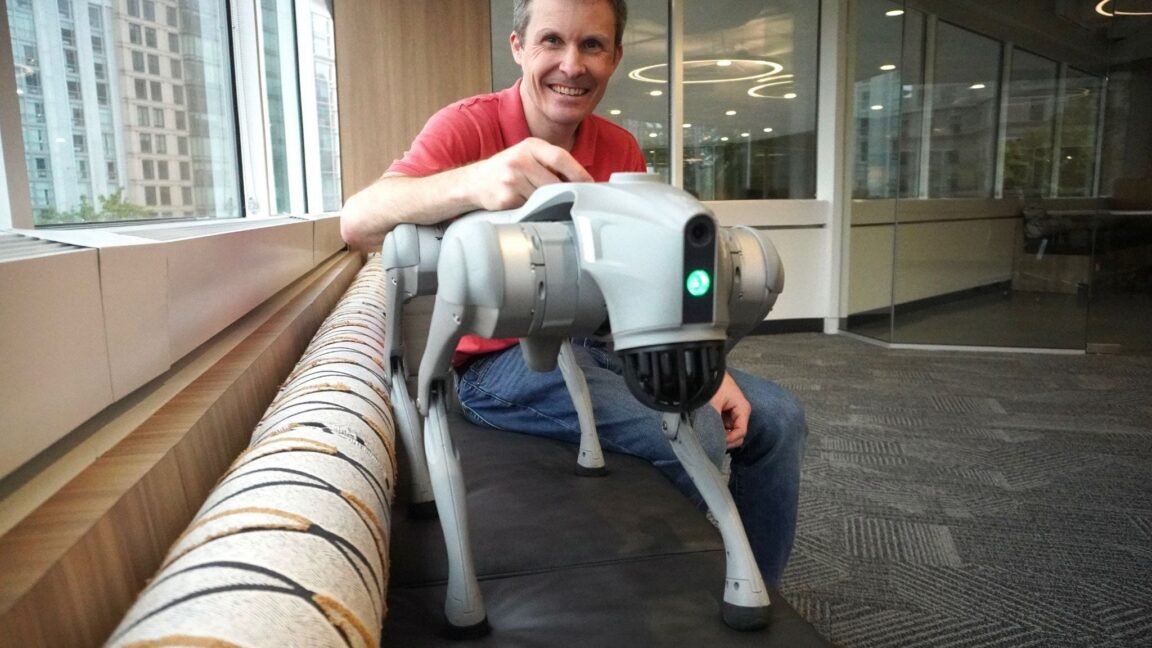
The Unitree robot dog price of $4,017 announced in the Ars Technica field report marks a watershed moment for legged robotics. By slashing the cost of a capable quadruped to under $5k, Unitree creates a new entry tier that challenges the dominance of premium platforms such as Boston Dynamics’ Spot, which starts near $75,000. This price compression mirrors historic diffusion patterns where a dramatic cost drop precedes mass adoption, similar to the personal computer boom of the 1980s. The original test was documented by Ars Technica, which provides the full context of the purchase and field trial.
Real-World Performance Metrics
In a two-mile commute through Washington, DC, the Go2 Pro maintained a steady gait downhill but struggled uphill in 30 °C ambient heat. Battery telemetry showed a remaining charge of 5 % and an internal temperature of 84 °C before the robot shut down and tipped onto its back. These data illustrate two engineering bottlenecks: thermal management and energy density. The lithium-polymer pack provides enough capacity for short urban trips but lacks headroom for sustained operation in warm climates or on steep grades. Users must therefore plan missions around cooling periods or accept reduced duty cycles.
Academic Adoption Accelerates
Professor Xuesu Xiao of George Mason University operates four Unitree quadrupeds, each costing about $15,000, a fraction of Spot’s price. He credits Unitree with “democratizing the entire world of quadruped locomotion research” (Ars Technica). The lower entry barrier enables more labs to experiment with gait algorithms, perception stacks, and reinforcement-learning pipelines without the overhead of custom hardware fabrication. Consequently, the open-source robotics community can iterate faster, potentially feeding improvements back into commercial products. This shift also lowers the barrier for interdisciplinary projects that combine robotics with biology, architecture, and education.
Market Valuation Signals Investor Confidence
Unitree’s IPO on the Shanghai Stock Exchange saw shares surge five-fold on debut, later stabilizing at a $34 billion market cap—over three times its pre-IPO valuation. The valuation reflects not only current quadruped sales but also the company’s strategic pivot to humanoid platforms priced at $13,500. Investors appear to bet on the scalability of Unitree’s manufacturing pipeline, which leverages mass-production techniques common in consumer electronics to drive down per-unit costs. If the company can maintain quality while expanding volume, the cost advantage may become sustainable.
Regulatory Headwinds in the United States
Despite the price advantage, Unitree faces emerging legal constraints. U.S. customs and the Federal Trade Commission have begun reviewing imported legged robots for compliance with safety standards and potential surveillance misuse. The collapse incident—overheating and uncontrolled shutdown—provides a concrete case study for regulators assessing risk. Should stricter certification become mandatory, the cost advantage could erode, mirroring the trajectory of drone regulation that introduced mandatory registration and performance caps.
Use-Case Limitations Highlighted by the Field Test
The author’s narrative underscores that the Go2 Pro lacks manipulators, limiting utility in household chores. Wheeled robots remain more energy-efficient for delivery tasks, while aerial drones excel at inspection. Consequently, the robot’s primary value proposition is novelty and research utility rather than functional assistance. However, the low price may spur niche applications—such as indoor mapping, educational kits, or low-budget entertainment—where cost constraints previously precluded legged platforms.
Incentives, Risks, and What Changes Next
Incentives: Universities and startups gain access to a platform that was previously out of reach, accelerating prototype development and talent training. Early adopters can differentiate their offerings by integrating legged mobility without incurring prohibitive capital expenditures.
Risks: Thermal failures raise safety concerns for public deployments, especially in crowded indoor environments. Without robust certification, manufacturers may face import delays or liability claims that increase total cost of ownership.
Future Changes: Expect Unitree to iterate on heat-sink designs or active cooling in future revisions. Advances in solid-state battery chemistry could extend range without adding weight. Policy evolution—particularly guidance from the FCC and CPSC—will likely shape market entry strategies, rewarding firms that obtain early compliance certification.
What to Watch Next
- Thermal Solutions: Look for revised chassis designs that incorporate passive heat spreaders or liquid cooling loops.
- Battery Chemistry: Solid-state cells could double energy density, reducing recharge intervals.
- Policy Evolution: Monitor FCC and CPSC statements regarding autonomous legged systems; early compliance guidance could become a market differentiator.
- Ecosystem Growth: As more universities acquire affordable quadrupeds, open-source software stacks (e.g., ROS 2) will likely see a surge in legged-robot packages, accelerating innovation cycles.
Investors, researchers and other stakeholders need to monitor advances in thermal management and related policy changes as the market develops. For those evaluating crypto-linked payments for robotics purchases, a friction-free exchange can streamline transactions a friction-free exchange.