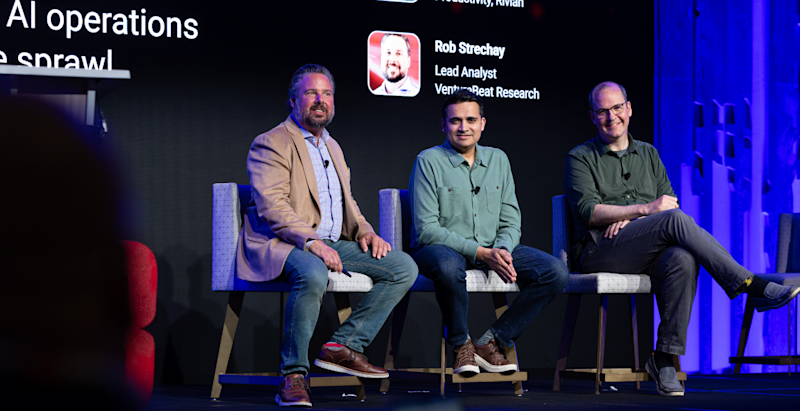
VentureBeat Lead Analyst Rob Strechay Expands Enterprise AI Research
Rob Strechay officially joined VentureBeat on August 19, 2026 as the publication's inaugural Lead Analyst. His appointment signals a strategic shift toward data-rich, architecture-focused research for CIOs, CTOs and other enterprise AI decision-makers. The move aligns with VentureBeat's goal to turn news snippets into defensible, metric-driven analysis of the rapidly evolving AI stack.
Context: Enterprise AI Moves From Pilot to Production
The enterprise AI market has reached a tipping point. VentureBeat's own VB Pulse surveys show that more than two-thirds of the 145 surveyed enterprises in June 2026 are hedging across multiple model providers rather than committing to a single vendor. The abrupt outage of Anthropic's Claude models forced many organizations to fall back on secondary providers. Executives now demand answers to three technical fault lines:
- Orchestration of heterogeneous model stacks – coordinating LLMs, retrieval-augmented generation pipelines, and domain-specific fine-tuned models across clouds.
- Security gaps in agentic pipelines – identity, provenance and data-leakage risks that scale with the number of autonomous agents.
- GPU and compute utilization inefficiencies – idle GPU cycles that inflate capex and opex, a problem Strechay highlighted in his May 2026 analysis of enterprise GPU waste.
These challenges require quantitative benchmarks, architectural blueprints and vendor-agnostic best practices, exactly the niche VentureBeat intends to fill with Strechay at the helm.
Impact: Depth of Analysis and New Research Vehicles
Strechay brings nearly three decades of hands-on experience across startups, Amazon Web Services, and analyst firms such as Enterprise Strategy Group and theCUBE Research. His technical pedigree enables him to dissect cloud-native AI infrastructure with the same rigor he applied when building AWS analytics services. The immediate impact of his hire can be broken into three operational dimensions:
Expanded Coverage of Cloud and Data Infrastructure
Strechay will focus on cloud infrastructure, advanced data pipelines, platform engineering, DevOps orchestration and observability. By mapping interaction points between AI workloads and underlying storage, networking and compute layers, his reports will provide concrete metrics, e.g., average GPU utilization percentages, latency distributions for RAG retrieval, and cost per inference across major cloud providers.
Integration With VB Pulse Surveys
VentureBeat's monthly VB Pulse surveys already track five pillars of enterprise AI adoption: agentic orchestration, agent reliability, security & identity, infrastructure & compute, and context layers. Strechay's analytical framework will embed deeper statistical modeling into these surveys, turning raw response counts into confidence intervals and trend forecasts. For example, the June report on agentic orchestration revealed a 66% hedging rate; Strechay will augment such findings with variance analysis and cross-regional comparisons.
Revamped VB In Conversation Series
The existing VB In Conversation video format will evolve from high-level market overviews to deep technical interviews. Strechay will host sessions that surface architectural diagrams, deployment bottlenecks and real-world performance data from leading AI platform teams. These episodes will be published on VentureBeat's site and YouTube channel, providing a permanent, searchable repository of production-grade insights.
Risk and Caveats: Data Fidelity and Market Dynamics
VentureBeat must manage several risks as it expands its research agenda:
- Survey bias – The VB Pulse relies on voluntary participation from enterprise IT teams. Non-response bias could skew utilization metrics, especially for smaller firms that lack formal AI governance.
- Vendor influence – VentureBeat deepens relationships with cloud providers for data access. The editorial team must guard independence to avoid perceived favoritism.
- Rapid model churn – The AI model landscape evolves weekly; benchmarks captured in a quarterly report may become obsolete within months. The research team must refresh data continuously.
Strechay’s prior experience at independent research firms shows he understands these pitfalls. He will employ triangulation methods, cross-referencing survey data with public cloud pricing APIs and third-party performance suites to improve reliability.
What Changes Next: Monitoring Signals and Ecosystem Shifts
The next six months will test VentureBeat's new research model. Key indicators to watch include:
- Adoption rate of VB Pulse surveys – A rise in participating enterprises would validate the value proposition of metric-driven insights.
- Publication cadence of Strechay’s deep-dive reports – Frequency and depth of white-paper-style analyses will reveal how quickly the team can translate raw data into actionable guidance.
- Feedback loops from VB In Conversation series – Viewer engagement metrics (watch time, comments) will indicate whether the technical audience finds the content sufficiently granular.
- Industry response – Competitors such as Forrester and Gartner may adjust their own enterprise AI research offerings, potentially leading to a more competitive analyst market.
Stakeholders—including cloud vendors, AI platform providers, and enterprise procurement teams—should monitor these signals to gauge how the new research output influences buying cycles and technology roadmaps.
Read Next: Amazon Data Center Climate Impact: A Growing Concern
For additional context, see the original press release on VentureBeat.
All factual statements are drawn from VentureBeat's press release dated August 19, 2026 and the accompanying VB Pulse survey results.
Related coverage
- Meta Open-Sources Muse Glimmer: A 30B Local Agentic Model
- Palantir CEO Criticizes AI Industry
- Micro1 $500M run rate signals AI data boom