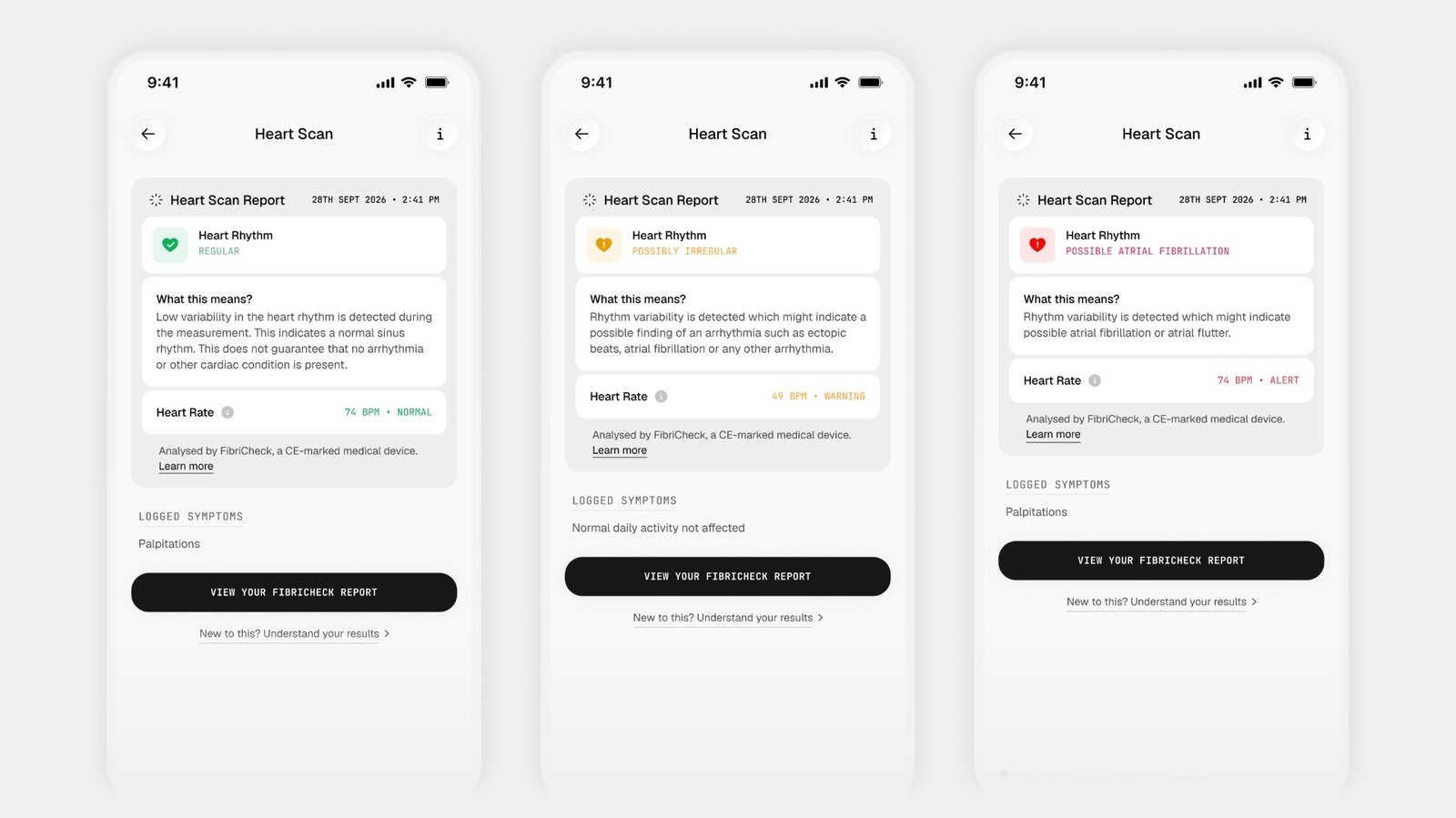
On October 7, 2026, wearable maker Ultrahuman announced a partnership with FibriCheck to roll out an on-demand heart rhythm detection feature called Heart Scan for its Ring Air and Ring Pro hardware. This capability expands upon the company's existing Atrial Fibrillation monitoring add-on, which previously focused solely on passive tracking during sleep intervals. By integrating FibriCheck's optical verification software, users gained the ability to execute Ultrahuman heart rhythm scans directly from the mobile application when experiencing unexpected health symptoms. The deployment changes how software monetization and diagnostic utility intersect in the consumer smart ring market.
Execution Mechanics and App Integration for Ultrahuman Heart Rhythm Scans
Unlike passive ring telemetry that continuously captures photoplethysmography data during sleep cycles, the newly introduced FibriCheck integration requires active user engagement. To initiate a scan, individuals open the Ultrahuman app and hold their finger or point the smartphone camera depending on the software prompt, remaining entirely stationary for a mandatory sixty-second window. The underlying FibriCheck algorithm then analyzes the optical stream to detect irregular heart rhythms. Following the diagnostic run, the application compiles the raw telemetry into a structured PDF document intended for direct handoff to a clinical practitioner, providing a verified time-series record instead of an abstracted summary.
While hardware-level continuous monitoring remains the primary value proposition of smart rings, reliance on background capture often misses acute, waking episodes of arrhythmia. By combining continuous background logging with an explicit on-demand capture loop, the platform attempts to bridge the gap between preventative ambient tracking and episodic clinical diagnostics. This dual-mode approach resembles protocols used in medical-grade consumer hardware, though optical smartphone capture introduces distinct lighting and motion artifacts that ring-based sensors circumvent. Developers must measure the accuracy trade-offs between camera-based optical sensors and dedicated photoplethysmography emitters embedded directly in the ring chassis.
Cost Structure and Regional Availability
For existing subscribers, the financial financial barrier to entry remains flat. Ultrahuman folded the Heart Scan functionality directly into its existing Afib Power Plug tier. Users who already pay for the atrial fibrillation add-on gain access to the feature without incurring incremental fees. However, geographic availability remains constrained. The feature rolled out exclusively within designated supported markets spanning the United Kingdom, Europe, the Middle East, and the Asia-Pacific region, leaving users in other territories without access until regulatory clearances widen.
The deployment model highlights a growing industry trend of monetizing specific algorithmic capabilities via modular software add-ons rather than broad hardware updates. Similar shifts are visible across consumer health platforms, such as when enterprise security groups deploy software-defined controls like the Okta-Led Alliance Proposes AI Agent Kill Switch to Secure Businesses to manage distinct operational boundaries. For Ultrahuman, keeping advanced diagnostic checks inside a recurring subscription tier secures a predictable software revenue stream while circumventing the lengthy regulatory hurdles associated with shipping entirely new diagnostic hardware modules.
Operational Consequences and Infrastructure Migration
Integrating third-party diagnostic algorithms into a proprietary hardware ecosystem introduces distinct engineering dependencies. Ultrahuman relies on FibriCheck for the signal processing pipeline, which means app performance depends heavily on external API uptime and data synchronization speeds between the smartphone app and cloud analysis servers. Developers migrating toward modular health stacks must evaluate latency thresholds during 60-second optical streaming tasks, as network drops invalidate the diagnostic session and force users to restart the entire capture cycle.
Furthermore, the handling of sensitive electrocardiogram and photoplethysmography data requires strict adherence to regional privacy frameworks like GDPR in Europe and HIPAA equivalents in other operational zones. Storage protocols must ensure that encrypted PDF exports are generated locally or transmitted securely without exposing raw physiological signals to secondary telemetry pipelines. Companies deploying these features absorb increased liability regarding diagnostic accuracy and data breaches, shifting the risk profile from simple activity tracking toward regulated medical device software distribution. Engineering teams must build robust fallback routines to handle dropped API connections gracefully without corrupting user health histories.
Related coverage
- Meta Muse Charm: Revolutionizing AI Assistants with Keychain Device
- AI Power Demands Surge During Climate Week, Prompting Grid Strain and Investment Shifts
- Spotify launches US Taste Profile, letting users edit recommendation algorithm