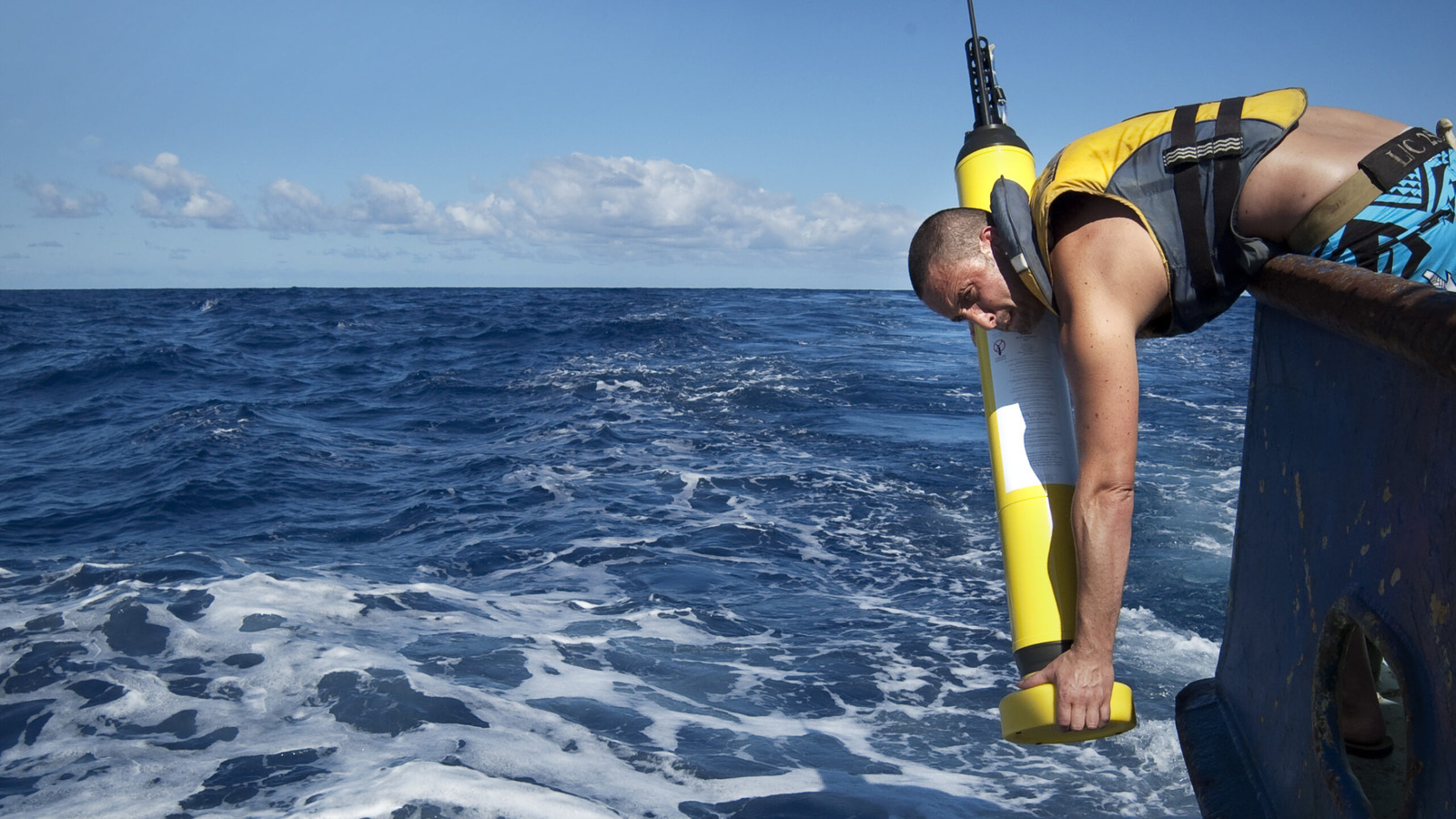
Ifremer announced that thirty new Deep-6000 autonomous floats will join the global Argo network by 2028, pushing the system’s theoretical coverage of ocean volume past 98%
Technical breakthrough and deployment timeline
The French state ocean agency disclosed that its two Deep-6000 prototypes completed five successful 6,000-meter dives between 11 January and 2 February 2026, demonstrating pressure-resistant composite hulls and a seven-year power budget. Each float weighs 88 lb, roughly double a standard Argo float, a trade-off that enables the hull to survive the ~600 atm pressure at abyssal depths. The devices follow a ten-day cycle: a nine-day drift at a mid-water “parking” depth, a three-hour deep-profile descent, ascent, and satellite telemetry upload. Battery capacity supports about 150 cycles, translating to three-to-five years of operation before replacement
Ifremer’s roadmap calls for the addition of 30 deep-sea units to the existing 4,000-float fleet, a modest numerical increase that disproportionately expands volume coverage because the new units operate in the 2,000-to-6,000 m band where 90% of the ocean’s mass resides. The United States already fields over 100 deep-sea floats and China more than thirty, but only three nations now possess hardware capable of reaching the abyssal zone
Why the abyss matters for climate science
Current Argo data underpin global ocean-temperature and salinity products used by the World Meteorological Organization and major climate-modeling centers. However, only five percent of the ocean has been directly sampled, and roughly ten percent of observed warming occurs below the 4,000-meter ceiling of legacy floats. By extending profiling depth to 6,000 m, the Deep-6000 fleet will capture temperature gradients, carbon sequestration rates, and oxygen minima that are currently inferred from sparse ship-based casts
“Tracking ocean warming all the way through abyssal depths will allow us to obtain information on deep ocean circulation, which contributes to the storage of climate signals such as heat and carbon,” explained Virginie Thierry of Ifremer in the agency’s press release. The additional data are expected to reduce uncertainty in sea-level rise projections and improve monsoon forecasts, because deep-water heat content influences surface temperature anomalies on multi-year timescales
Engineering constraints and cost considerations
Designing a pressure-proof, self-sustaining platform required abandoning pure titanium in favor of a composite laminate that balances strength, weight, and corrosion resistance. The 88-lb mass is intentional: a heavier hull reduces the risk of implosion while still fitting within the launch-from-ship envelope used for standard Argo floats. Power is supplied by high-energy density lithium-ion cells paired with a low-drift acoustic modem for satellite uplink, enabling the seven-year operational window without external recharging
Cost control remains a central concern. Ifremer’s head of profiler technology, Xavier André, emphasized that the Deep-6000 design targets a unit price comparable to existing Argo floats, despite the added material and testing expenses. Maintaining a low per-unit cost is essential for scaling the fleet beyond the planned 30 units, as future expansions will likely depend on contributions from the broader international Argo community
Operational impact and data pipeline integration
All Argo data are freely available through the Global Ocean Data Assimilation System (GODAS) and are ingested by climate-modeling pipelines such as the Coupled Model Intercomparison Project (CMIP). The Deep-6000 profiles will be formatted identically to legacy floats, ensuring seamless integration. However, the increased data volume—potentially an extra 30 × ~100 profiles per year—will require modest upgrades to the satellite relay bandwidth and ground-station processing queues. Early tests indicate that the existing Iridium-based telemetry chain can accommodate the load with a software patch, avoiding costly hardware overhauls
Geopolitical and regulatory dimensions
The expansion underscores a subtle shift in ocean-monitoring leadership. France’s entry into the deep-sea float arena places it alongside the United States and China, the only other nations with proven abyssal-capable hardware. While the Argo program is governed by the International Oceanographic Data and Information Exchange (IODE), each nation retains sovereignty over its float deployments. This raises questions about data sharing policies for the newly captured abyssal data, especially if strategic interests (e.g., submarine navigation, resource exploration) intersect with climate science
Regulators in the European Union have begun drafting guidelines for autonomous underwater vehicle (AUV) operations beyond the Exclusive Economic Zone, focusing on collision avoidance and marine-life impact. Ifremer’s floats are designed to be passive drifters with no propulsion, mitigating many of the concerns that have stalled other AUV initiatives. Nonetheless, the upcoming fleet will be the first large-scale, deep-ocean autonomous system operating under the new EU framework, providing a test case for future policy refinement
Market and industry ripple effects
The Deep-6000 rollout could stimulate a niche market for high-pressure composite hulls, acoustic modems, and long-life battery chemistries. Companies that supply marine-grade carbon-fiber laminates may see increased demand, while satellite providers could market specialized data-plan packages to research institutions. Moreover, the success of the Deep-6000 may encourage private-sector players—such as offshore energy firms—to adopt similar platforms for subsea infrastructure monitoring, creating a feedback loop between scientific and commercial underwater sensing
What to watch next
The next milestone will be the first operational deployment of a Deep-6000 float from a research vessel in mid-2026, followed by the release of the inaugural abyssal-depth dataset in early 2027. Analysts will monitor data latency, battery performance, and any anomalies in pressure-hull integrity. A key indicator of broader adoption will be whether the International Oceanographic Commission incorporates the Deep-6000 specifications into the next version of the Argo standard, effectively institutionalizing the deeper profiling capability
For a broader view of how autonomous platforms are reshaping data ecosystems, see the recent analysis of Google’s AI-economics research team Google Adds Nobel Laureate and Top Economists to AI & Economy Research Team.
Conclusion
Ifremer’s Deep-6000 program represents a focused engineering advance that could close a critical blind spot in Earth-system observation. By extending the Argo network’s reach into the abyssal zone, the initiative promises to tighten climate-model constraints, stimulate specialized marine-technology markets, and test emerging regulatory frameworks for deep-sea autonomy. The coming years will reveal whether the modest fleet of thirty floats can deliver the promised 98% ocean-volume coverage and, more importantly, whether that coverage translates into measurable improvements in climate prediction and policy-relevant insight.
Related coverage
- Is the Original Nintendo Switch 2026 Still Worth Buying?
- Retroid Pocket Duo Lite Plus Expands Handheld Gaming Options
- T-Mobile and AT&T Expand 5G Home Internet, Challenging Wired Broadband