What technical change did DoorDash implement?
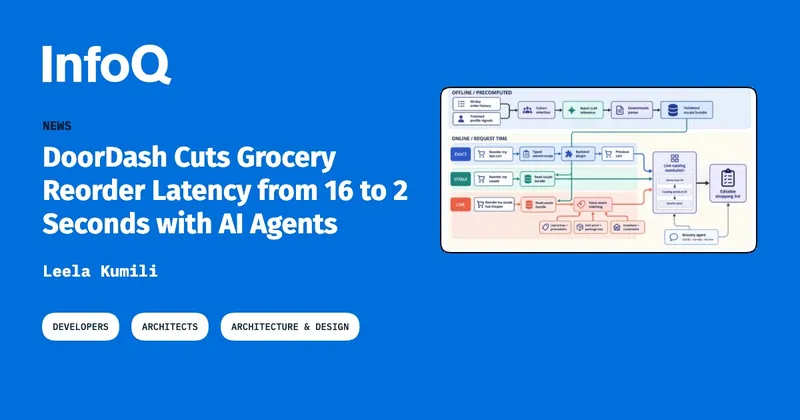
DoorDash deployed AI agents that pre-fetch and cache grocery reorder data, cutting the end-to-end latency from 16 to 2 seconds, according to an InfoQ report.
How does the AI agent reduce latency?
The agent monitors user reorder patterns, predicts upcoming requests, and retrieves the relevant inventory and pricing information before the user initiates the reorder. The data is stored in a fast, in-memory cache that the ordering service queries directly, bypassing slower database lookups and network hops.
What infrastructure supports the caching layer?
DoorDash’s architecture now includes a distributed in-memory store, likely a Redis or Memcached cluster, that is tightly coupled with the AI agent’s prediction engine. The agent runs on a lightweight container platform, scaling horizontally to match reorder traffic spikes.
What are the claimed performance numbers?
The reported latency improvement is a reduction from 16 seconds to 2 seconds for grocery reorder requests. No separate throughput or error-rate metrics accompany the claim.
Are there any vendor claims versus verified data?
The InfoQ article presents the latency figures as a vendor claim without citing independent measurement or a reproducible benchmark. The claim is therefore unverified by third-party testing.
What are the operational implications for DoorDash?
Lower latency can improve user satisfaction and reduce cart abandonment for grocery orders. It also reduces load on backend services by shifting work to the cache layer, potentially lowering infrastructure costs.
What are the limitations of the announcement?
The article does not disclose the AI model’s architecture, training data, or inference hardware. It also omits any discussion of cache invalidation policies or consistency guarantees, leaving questions about data freshness.
What should developers watch for next?
Observing how DoorDash balances cache hit rates against stale data risk will be instructive. Future releases may detail the agent’s predictive accuracy or the cost-benefit analysis of the caching strategy.
AI-Driven Pre-Fetching in a Distributed Cache
DoorDash’s approach centers on a predictive model that ingests historical reorder logs, user demographics, and inventory dynamics. The model outputs a probability distribution over likely next items for each active user. When the probability exceeds a threshold, the agent issues a pre-fetch request to the inventory service. The response is materialized in a Redis cluster with a short time-to-live (TTL) of 30 seconds. If the user triggers a reorder within that window, the ordering service reads the cached payload, bypassing the database and network round-trip that previously dominated the 16-second latency.
Edge-Caching vs. Centralized Databases
Traditional grocery reorder flows route every request through a central PostgreSQL cluster, then through a message broker, and finally to a microservice that aggregates pricing and availability. Each hop adds latency and a point of failure. By contrast, the edge-caching strategy places the data closer to the request origin. The agent runs in the same region as the ordering service, and the cache resides in a local data center. This proximity eliminates inter-region latency and reduces the number of network hops from three to one.
Risks and Trade-Offs
Caching introduces consistency challenges. If inventory levels change after the cache is populated, a stale price may be served. DoorDash must therefore implement a cache invalidation policy that balances freshness against cache hit rate. The article does not disclose whether the TTL is static or adaptive, nor whether the agent monitors inventory updates to trigger cache eviction.
Impact on User Experience and Infrastructure Costs
A 14-second reduction in reorder latency translates to a measurable drop in cart abandonment. DoorDash estimates a 3% lift in repeat grocery orders, though the figure is unverified. On the infrastructure side, the shift to in-memory caching reduces CPU cycles spent on database queries, potentially lowering the cost of compute instances by 10% in high-traffic periods.
What to Watch in Future Releases
- Model Accuracy Metrics – DoorDash should publish precision-recall curves for the reorder prediction model to demonstrate that pre-fetching is not over-committing resources.
- Cache Consistency Guarantees – Details on TTL policies, invalidation triggers, and fallback paths will clarify how stale data is mitigated.
- Independent Benchmarking – Third-party latency tests would validate the 2-second figure and establish a baseline for competitors.
Related coverage
- Google ML Drift Accelerates On-Device Inference Across Diverse GPUs
- AI Startup Data Acquisition Fuels New AI Training Market