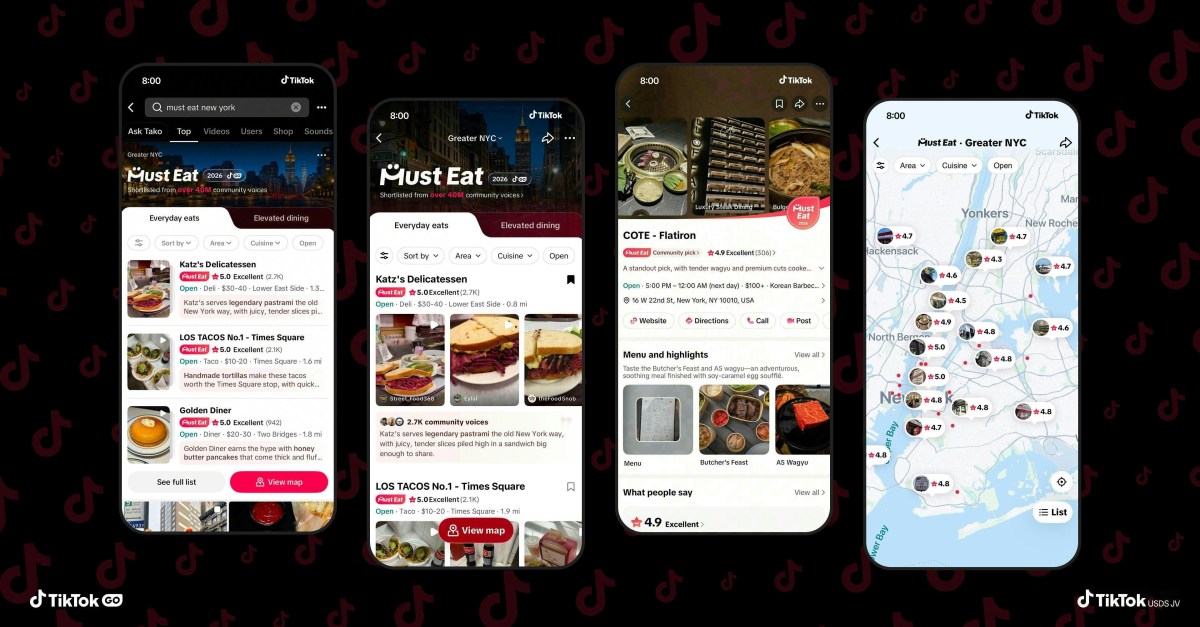
TikTok Must Eat launches an in-app restaurant guide that pulls 40 million food-related posts, reviews, and comments into a searchable interface. The move positions TikTok directly against Yelp and Google Maps, offering a video-centric alternative that lets users discover, review, and book restaurants without leaving the app.
How Must Eat Aggregates Content
Must Eat pulls from TikTok’s existing library of dining videos, comments, and creator-generated reviews. The platform categorizes listings into "everyday eats" and "elevated dining," allowing users to filter by rating, distance, cuisine, and current hours. Each restaurant page links directly to the videos that mention or feature the business, creating a video-centric review ecosystem.
Built-in Reservation and Review Flow
The feature embeds a reservation widget that connects to third-party booking services. Users can call the restaurant or reserve a table without leaving TikTok. Reviews are posted as short text snippets accompanied by the user’s video or comment, and can be up-voted or down-voted by the community.
Geographic Rollout and Availability
Must Eat launched in three U.S. metros: New York City, Los Angeles, and the Bay Area. The initial rollout focuses on high-density dining markets where TikTok’s user base is strongest. The app currently does not support international expansion.
No Paid Placement Policy
TikTok explicitly states that restaurants cannot pay to appear in Must Eat’s recommendation lists. This policy differentiates the service from Yelp’s paid advertising model and positions Must Eat as a community-driven alternative to curated guides like The Infatuation.
Integration with TikTok Go
Must Eat extends TikTok Go’s earlier hotel and attraction booking capability. TikTok Go allowed creators to tag and link to locations; Must Eat applies the same model to restaurants, enabling a seamless transition from discovery to booking.
Impact on the Dining Ecosystem
The platform’s influence on restaurant traffic is notable. TikTok claims that 27 million U.S. diners visited a new restaurant, café, or shop for the first time in 2025 thanks to the app. Must Eat could amplify that effect by providing a structured recommendation engine.
Competitive Landscape
Must Eat sits between Yelp’s review-heavy model and curated guides such as The Infatuation. Its reliance on user-generated video content offers a unique angle, but the lack of paid placement may slow initial growth compared to competitors that monetize listings.
Technical Considerations for Developers
Developers building restaurant-related services can leverage TikTok’s API to pull video metadata, user comments, and location tags. The reservation widget uses a standard OAuth flow to connect to external booking providers, simplifying integration.
Open Questions
- How will TikTok handle moderation of user reviews and comments to prevent spam or defamation?
- Will the platform introduce paid placement or premium listings in future iterations?
- How will Must Eat scale beyond the initial three metros, and what metrics will drive expansion?
The launch of Must Eat marks TikTok’s most ambitious foray into the dining space yet, blending short-form video with traditional restaurant discovery tools.
Related coverage
- r/opensource AI ban sparks rift over non-English posts
- Google privacy policy now permits Gmail data to feed ad targeting via Personal Intelligence