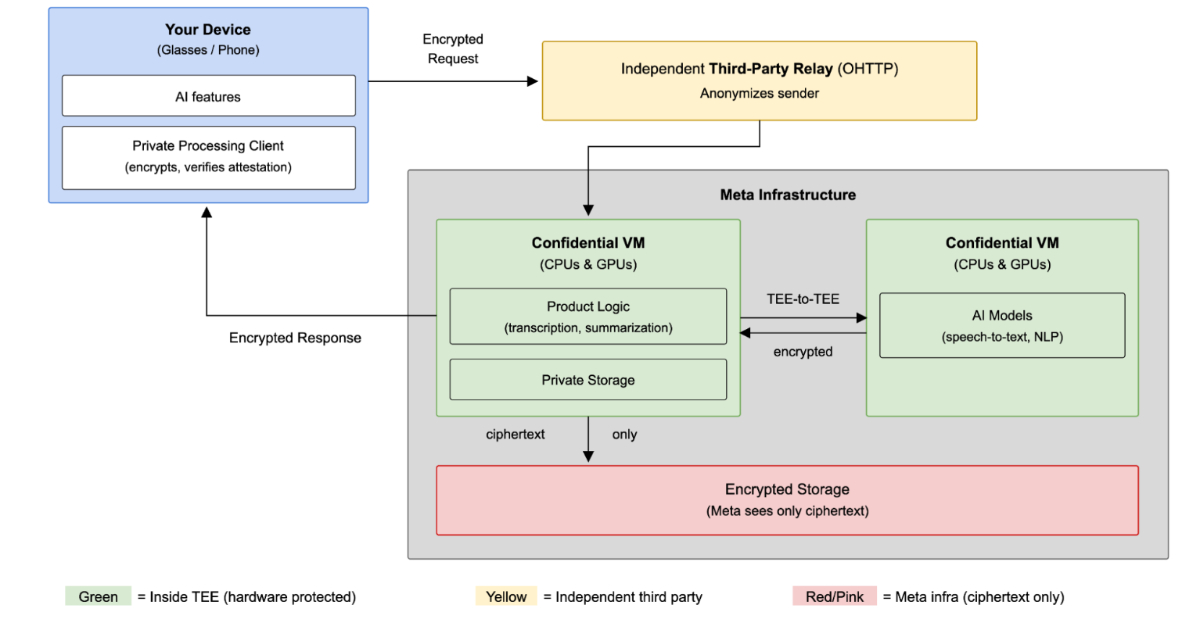
Meta confidential computing now runs on its AI glasses, enabling private inference that stays entirely on the device. The announcement, published on 9 Oct 2026, states that the glasses now run machine-learning models inside secure enclaves that mirror Intel SGX architecture. The data captured by the glasses’ cameras and sensors never leaves the hardware, and the models cannot be inspected by the host operating system.
How the Enclaves Work
Meta’s implementation builds on a custom silicon layer that exposes a Trusted Execution Environment (TEE). The TEE isolates the inference engine and the model weights from the rest of the system. When the glasses capture a frame, the image is fed directly into the enclave, where a lightweight neural network performs object detection or gesture recognition. The output is then returned to the user interface without exposing the raw image.
The enclave uses a 64-bit ARMv8.4 architecture with a 1.2 GHz Cortex-A78 core and 2 GB of dedicated RAM. The secure memory is encrypted with a 256-bit AES key that is generated at manufacturing time and never leaves the chip. Meta claims the enclave can process up to 30 frames per second on a 224×224 input, matching the performance of the cloud-based models that the glasses previously relied on.
Impact on Deployment Cost
Meta has not released detailed cost figures for the new silicon. The announcement notes that the confidential computing module adds roughly 10 % to the bill of materials, but it does not quantify the impact on the final retail price. Developers will need to port their models to the enclave’s restricted API, which may require additional tooling and testing.
Comparison to Previous Releases
Earlier versions of the glasses used a standard ARM Cortex-A55 core for inference, offloading heavy models to Meta’s edge servers. The new confidential computing feature removes that dependency, allowing the glasses to operate offline and comply with stricter privacy regulations. However, the announcement does not provide latency numbers or energy consumption data, leaving open questions about real-world performance.
What Developers Need to Know
To take advantage of the enclave, developers must use Meta’s new SDK, which exposes a limited set of tensor operations and a secure key-exchange protocol. The SDK also includes a sandboxed runtime that prevents the enclave from accessing the file system or network stack. Because the enclave cannot write to persistent storage, developers must design models that fit within the 2 GB memory budget.
Meta encourages developers to test their models on the new hardware using a simulator that mimics the enclave’s constraints. The simulator is available as part of the Meta AI Development Kit (AIDK) and can be downloaded from the Meta developer portal.
Regulatory and Privacy Implications
The move aligns with growing regulatory pressure on consumer AR devices to protect user data. By keeping inference local, Meta can avoid transmitting personally identifiable information to its servers, potentially easing compliance with GDPR and CCPA. The announcement does not address whether the glasses will still collect metadata such as location or usage statistics.
Open Questions
- What is the actual power draw of the enclave compared to the previous CPU-based inference path?
- How does the enclave handle model updates—are they signed and verified before deployment?
- Will Meta offer a cloud-based fallback for models that exceed the enclave’s memory limits?
Meta confidential computing extension represents a significant step toward privacy-first AR, but the lack of performance and cost data means developers and consumers will need to wait for real-world trials to assess its viability.
For more on how privacy concerns are shaping enterprise AI, see the recent discussion on the Okta-Led Alliance Proposes AI Agent Kill Switch to Secure Businesses.
Related coverage
- Samsung Tizen Update Policy Extends Smart TV Support to Seven Years
- Open-Weight Models Face Cyber-Attack Claims Amid Debate on Democratization
- Former IBM Strategist Questions Enterprise AI Legacy IT Modernization Economics