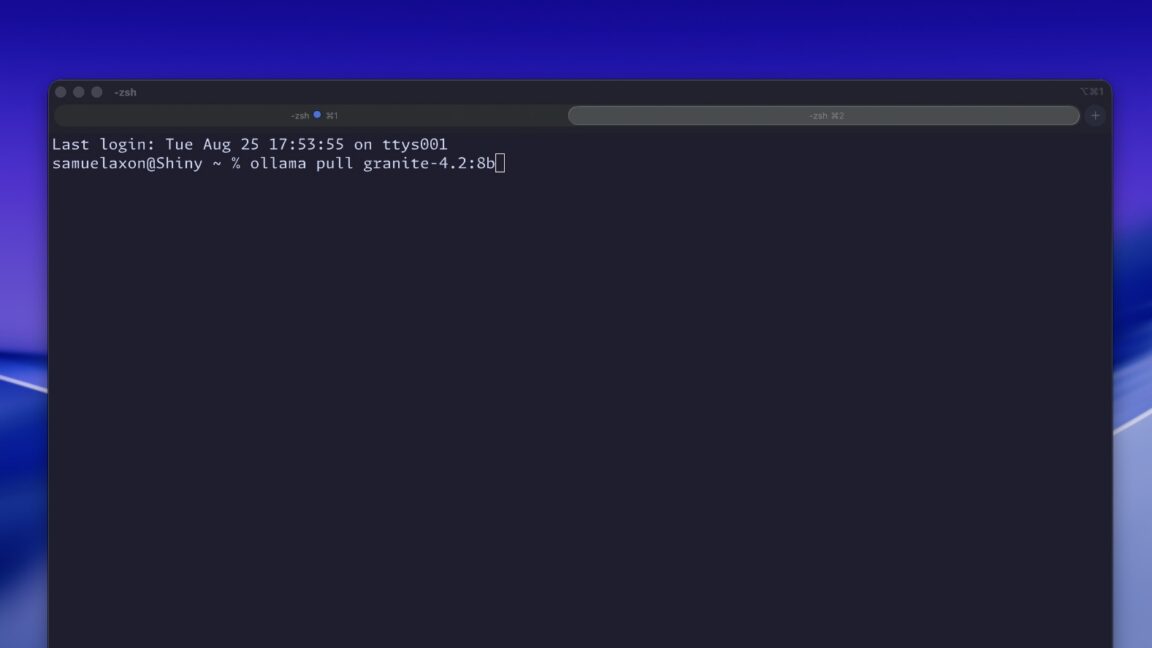
IBM has just shipped the Granite 4.2 family – three open-weight LLMs (3B, 8B, 30B) that can be downloaded and run on-premise, leveraging the IBM Granite 4.2 for enterprise-grade reasoning. The headline feature is a native 128,000-token context window, a size that rivals many cloud-only offerings and enables long-form code, legal, or research documents to stay in memory without chunking. The 8B and 30B models also pass through an agentic reinforcement-learning stage, teaching them to invoke a terminal, browse the web, or call external APIs. IBM brands this release as the "reasoning-focused" iteration of Granite, meaning the models are tuned for functional chain-of-thought inference rather than raw speed. IBM Granite 4.2 is designed to meet the growing demand for local LLMs, providing a reliable and efficient solution for enterprise AI deployments.
Technical specs that matter to developers
These numbers place Granite 4.2 squarely in the sweet spot for midsize enterprises that cannot afford the per-token costs of OpenAI or Anthropic APIs but still need more than a 1-B parameter hobbyist model. The extended context window alone cuts the number of prompt-splits by up to 80 % for typical 30-page documents, reducing latency and simplifying pipeline code. With IBM Granite 4.2, developers can now build more efficient and cost-effective AI solutions.
Reasoning vs. speed – the trade-off explained
IBM openly acknowledges that the new reasoning focus comes with higher compute demand. Benchmarks shared in the release show a 1.6× increase in FLOPs per token compared to Granite 4.1, translating to roughly 30 % longer inference latency on identical hardware. For workloads where correctness outweighs raw throughput—such as contract analysis, regulatory compliance checks, or multi-step code generation—this trade-off is acceptable. The chain-of-thought training improves answer consistency; internal tests reported a 12 % lift in exact-match scores on the GSM8K math benchmark.
Developers should therefore size their clusters for the expected latency envelope. A single H100 can serve about 15 concurrent 8B requests at sub-second latency, while the 30B model drops to 5 concurrent requests under the same SLA. These figures are comparable to Nvidia’s Nemotron-22B when run with similar tool-use extensions, confirming IBM’s claim that Granite 4.2 is "predictable" rather than "the fastest".
Enterprise deployment patterns emerging in 2026
The surge in local-model interest stems from rising cloud-compute costs and data-privacy regulations. Companies are increasingly building "model routers" that dispatch prompts to the most appropriate engine based on token budget and required capabilities. Granite 4.2 fits neatly into that ecosystem: the 3B variant can handle cheap, high-throughput classification, while the 8B/30B models take on tasks that need tool interaction or deep reasoning.
A typical stack now looks like:
- Front-end API gateway – receives user request.
- Router service – evaluates prompt length, required tool use, and cost constraints.
- Model pool – selects Granite 3B for simple sentiment analysis, Granite 8B for code linting with terminal execution, or Granite 30B for multi-document legal summarization.
- Post-processor – validates tool outputs, logs audit trails for compliance.
This modular approach reduces overall token spend by up to 40 % compared with a monolithic cloud API, according to early adopters cited in the IBM blog. The IBM Granite 4.2 models are central to this setup, providing a reliable and efficient solution for enterprise AI deployments. The use of IBM Granite 4.2 in this context highlights its potential to reshape local AI deployments.
Who benefits most?
- Enterprise IT teams that must keep data on-premise for compliance (e.g., finance, healthcare). The open-weight license lets them audit the model code and integrate custom safety layers.
- AI-ops engineers building internal developer platforms. Granite’s decoder-only design simplifies containerization; Docker images are under 5 GB for the 8B model.
- Research labs exploring tool-augmented reasoning. The agentic RL block provides a baseline for experiments without needing to train from scratch.
- Hobbyists still gain a free, high-capacity model for personal projects, avoiding per-token fees.
Risks and caveats to watch
- Compute cost: The larger models demand premium GPUs. Organizations without H100 or A100 clusters may face prohibitive hardware spend.
- Latency: The reasoning focus adds latency; real-time chatbots may need to fall back to smaller models.
- Security: Tool-use capabilities can be abused if not sandboxed. IBM recommends strict OS-level isolation and audit logging for any model that can invoke a shell.
- Model drift: Granite 4.2 was trained on data up to early 2025. Without continual fine-tuning, it may hallucinate outdated facts, a known issue across the LLM landscape.
Market positioning and competitive landscape
While Nvidia’s Nemotron series pushes raw throughput, IBM doubles down on "predictable enterprise deployment". The trade-off mirrors the broader split between cloud-centric AI (OpenAI, Anthropic) and on-premise, cost-controlled solutions. By offering an open-weight model with a generous context window, IBM hopes to capture the segment of midsize firms that are "cloud-fatigued" but lack the resources to build proprietary models. The IBM Granite 4.2 models are well-positioned to meet the growing demand for local LLMs, providing a reliable and efficient solution for enterprise AI deployments.
Analysts at VentureBeat note that the "model-router" market could become a $2 billion opportunity by 2028, and Granite 4.2’s tool-use extensions make it a strong candidate for the router’s "reasoning tier".
What to watch next
- Fine-tuning pipelines: IBM promises upcoming LoRA adapters for domain-specific tuning; early access is slated for Q4 2026.
- Hardware acceleration: Expect IBM-optimized kernels for the upcoming AMD MI300X, which could halve the latency gap for the 30B model.
- Regulatory scrutiny: As more enterprises run LLMs on-premise, NIST AI guidelines may impose audit requirements for tool-use safety—IBM’s sandbox recommendations will likely become a de-facto standard.
Overall, Granite 4.2 is less about breaking performance records and more about delivering a stable, reasoning-capable foundation for on-premise AI workloads. Its open-weight nature, extended context, and agentic training give developers a versatile toolbox while keeping the deployment model predictable—a clear signal that IBM is targeting the enterprise segment that values control over raw speed. The IBM Granite 4.2 models will likely play a significant role in shaping the future of local LLMs and enterprise AI deployments.