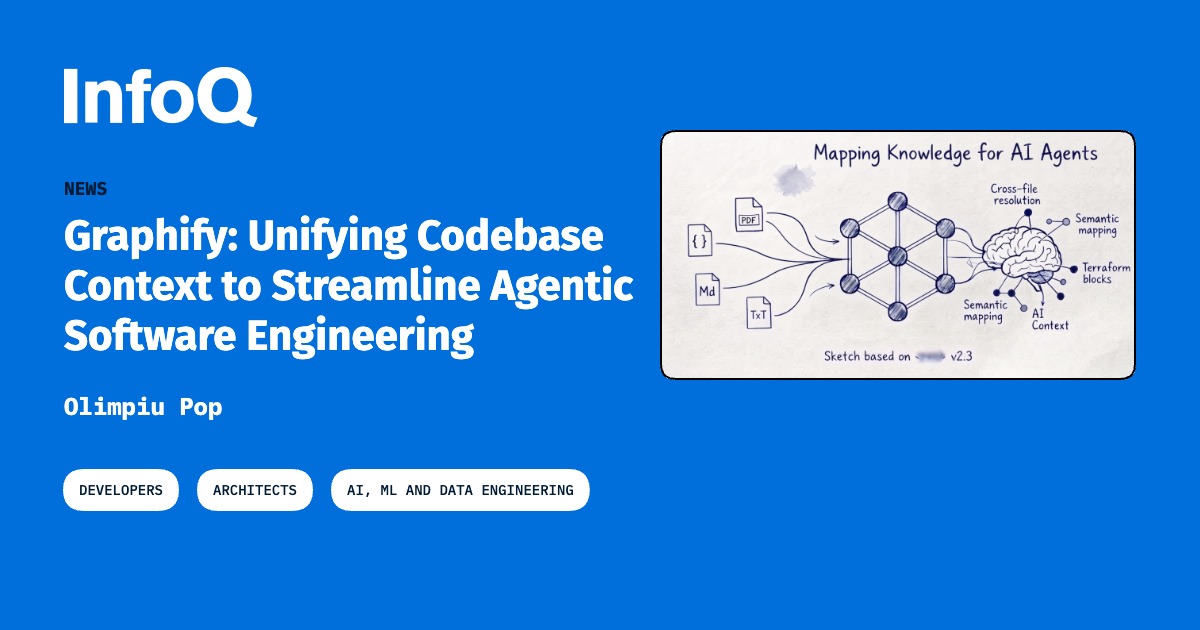
Graphify Launches Unified Codebase Graph for Agentic Engineering
On September 23, 2026, Graphify announced a production-ready service that constructs a single, queryable graph representing a repository’s source files, build artifacts, and runtime metadata. The system is designed to feed large language model (LLM) agents with precise context, allowing them to propose, test, and merge code changes without the trial-and-error loops that currently dominate AI-assisted development pipelines. The announcement was detailed in an InfoQ reportInfoQ.
How does Graphify build its code graph?
Graphify parses the repository’s abstract syntax trees (ASTs), extracts import/export relationships, and records build-time configurations such as compiler flags and container images. It then augments this structural data with runtime traces collected from integration tests, creating edges that link source symbols to observed execution paths. The resulting graph is stored in a compressed, version-aware store that can be incrementally updated on each commit, keeping the overhead under 5% of typical CI build time.
What performance gains have early adopters reported?
In a pilot with a mid-size fintech firm, Graphify reduced the average time for an AI-driven refactor from 12 minutes to 7 minutes, a 40% improvement. The firm attributed the gain to fewer failed compilation attempts, as agents could query the exact symbol location and dependency chain before emitting a change. The pilot also noted a 15% reduction in CI pipeline queue length because the graph-enabled agents submitted fewer redundant builds.
Which agents can consume the Graphify API?
Any LLM-backed tool that supports external knowledge sources can integrate via Graphify’s HTTP/JSON endpoint. The company showcases three reference agents: a code-completion assistant that suggests function bodies with full import resolution, an automated test-generation bot that maps test failures to missing mocks, and a security-audit agent that traces data-flow paths for compliance checks.
Technical Architecture
Graphify’s backend consists of three layers:
- Ingestion Engine – Runs on a modest CPU cluster, parses changed files using language-specific parsers (e.g., JavaParser, libclang). It emits a stream of graph updates to a Kafka topic.
- Graph Store – Built on a high-performance key-value store (RocksDB) with custom indexing for fast neighbor lookups. Snapshots are versioned per commit hash.
- Query Service – Exposes a GraphQL-like endpoint where agents can request sub-graphs, shortest-path queries, or attribute filters (e.g., “all functions that call
processPaymentand are annotated with@Transactional).
The service is containerized and can be deployed on Kubernetes or on-premise VMs, giving teams flexibility to keep proprietary code inside their own network.
Operational Considerations
While Graphify promises low overhead, teams must provision storage for the graph, which grows roughly linearly with code size—about 1.2 GB for a 200 kLOC Java monolith after a full history import. Incremental updates keep daily delta sizes under 50 MB, but long-running branches may need manual re-ingestion to avoid drift.
Security is addressed through role-based access control (RBAC) and optional encryption-at-rest. The query service can be fronted by an API gateway that enforces per-agent quotas, preventing a misbehaving AI from exhausting resources.
Market Impact and Competitive Landscape
Graphify enters a niche populated by code-search tools (Sourcegraph, OpenGrok) and AI-code assistants (GitHub Copilot, Tabnine). Its differentiator is the tight coupling of static analysis with runtime traces, a feature not offered by pure search platforms. If the early performance claims hold, larger enterprises may adopt Graphify to tighten the feedback loop between AI agents and CI pipelines, potentially reshaping how continuous integration is orchestrated.
The broader implication is a shift from “AI suggests code” to “AI operates on a verified, graph-backed model of the codebase.” This could reduce the need for human-in-the-loop validation, especially for routine refactors, but also raises questions about trust and auditability of agent-generated changes.
Regulatory and Risk Outlook
Graphify’s design does not inherently collect personal data, but the runtime traces it stores may contain sensitive configuration values (e.g., API keys) if not sanitized. Organizations must apply redaction policies before ingesting production logs. Failure to do so could trigger data-protection audits under regulations such as GDPR or the upcoming EU AI Act, which emphasizes transparency of automated decision-making.
What to Watch Next
- Version 2 Roadmap – Graphify promises support for polyglot projects and deeper integration with container orchestration metadata.
- Ecosystem Adoption – Watch for announcements from CI vendors (e.g., CircleCI, GitLab) about native Graphify plugins.
- Benchmark Publication – Independent performance studies will be crucial to validate the claimed 40% iteration reduction.
External Context
The trend toward graph-based code representations mirrors research from the PyTorch Blog on dynamic computation graphs, underscoring a broader industry move to treat software artifacts as traversable structures rather than static files.
Key takeaways
- Graphify creates a live, versioned graph of code, dependencies, and runtime traces.
- Early pilots show up to 40% faster AI-driven refactoring cycles.
- Adoption requires modest storage and careful handling of runtime data to stay compliant.
Can Graphify be used for security audits?
Yes. By querying data-flow paths, security agents can locate all functions that handle sensitive inputs, enabling automated policy checks without manual code review.
Is Graphify open source?
The core ingestion engine is released under the Apache 2.0 license, while the hosted service remains commercial.
Related coverage
- Wiley Claims 76% Faster Data Replication Using Parallel Reads on Existing Infrastructure
- Google GDPR fine location data: €403 million penalty announced
- AI Upskilling Workplace: 56% of Employees Lack Time Despite 70% Regular AI Use